





"Can we actually get married in Denmark?" It's one of the most common questions I hear from LGBTQIA+ couples from all over the world. And the answer is yes: whatever your gender identity is, whatever your sexual orientation, whoever you are, whoever you love. Gay, lesbian, bi, trans, non-binary, queer, everybody: if you and your partner want to marry here in Denmark, the law makes no distinction between you and anyone else.
You just need to be two adults. That's all.
I'm Martina Lanotte (she/they), a queer wedding photographer based in Copenhagen, and the author of Representation, a guide to inclusive LGBTQIA+ wedding photography. → more about me
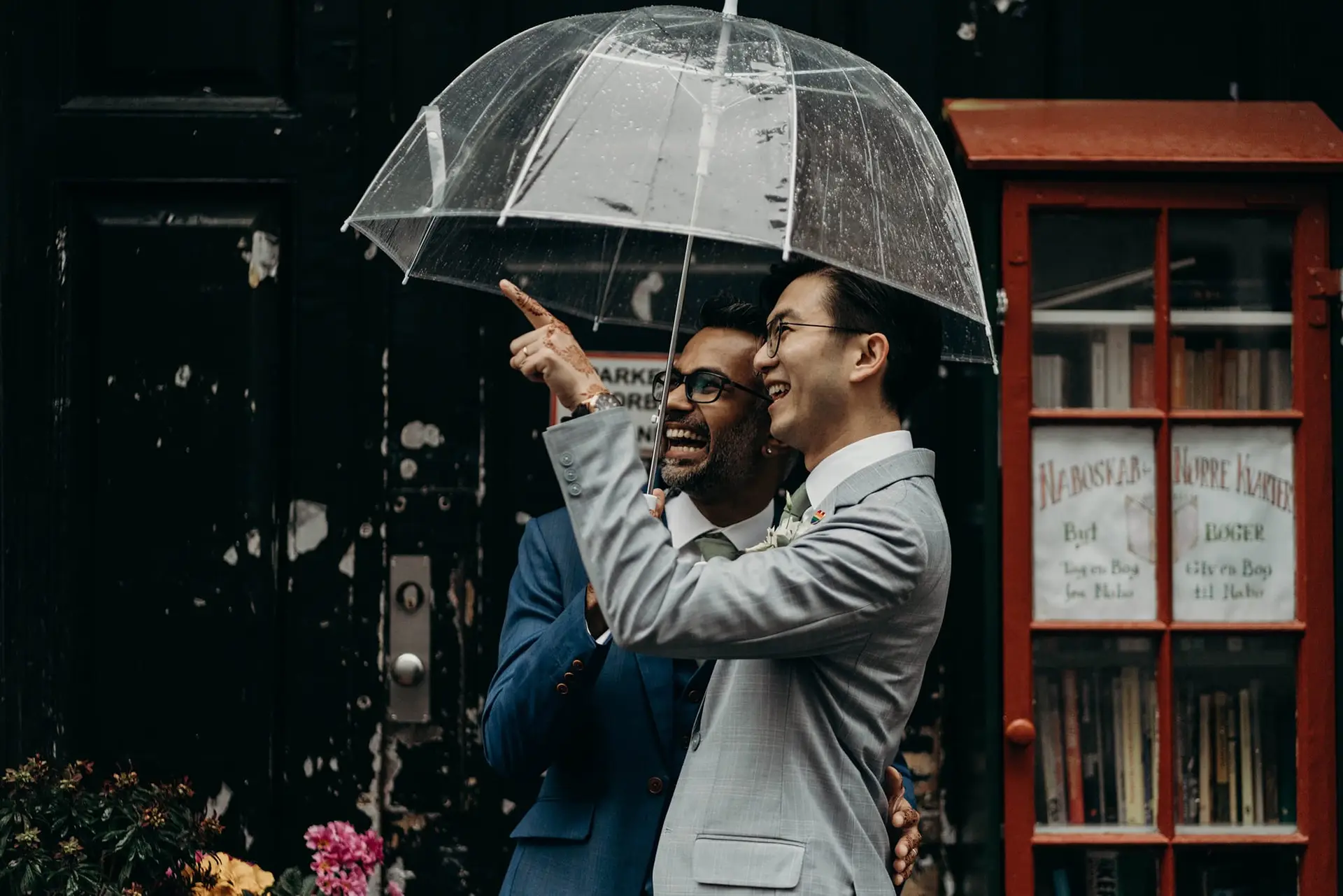
Is gay marriage legal in Denmark?
Equal marriage has been legal in Denmark since 15 June 2012, and so not just "gay" marriage: lesbian, bi, trans, non-binary, and queer couples too. Everybody is equal under the law.
What we mean by gay, same-sex and LGBTQIA+ marriage
You'll see words like "gay" and "same-sex" a lot on this page, in the headings especially. That's not because they're the words that best describe everyone here. We know that those are not umbrella terms, but that’s what people actually type into Google: roughly two out of three searches use "gay" alone, and we want this page to be reached by the people who need it.
We're aware that's an imperfect system. So rather than pretend it isn't happening, we're telling you directly: when a heading says "gay marriage", it's speaking Google's language so it can find you. It’s our little trojan horse.
Nevertheless, gay marriage, same-sex marriage, LGBTQIA+ marriage: in Denmark, these are all the same marriage, under the same law, with the same identical certificate. Whichever word describes you, the answer on this page is the same.
When did Denmark legalise same-sex marriage?
Denmark recognised same-sex registered partnerships in 1989, the first country in the world to do so. Full equal marriage followed on 15 June 2012. In 2014 it became the first country in Europe to allow legal gender change by self-declaration.
Read the full story, from 1948 to today
The road to what became the 1989 registered partnership law stretches back decades, to activists like Axel and Eigil Axgil, who founded Denmark's first gay rights organisation in 1948 and spent the rest of their lives pushing for exactly this kind of recognition. When the bill finally came to a vote in parliament, in 1989, Danish members of parliament were free to vote by conscience rather than by party line, and the bill passed 71 to 47, with 5 abstentions. People watching from the gallery stood and applauded.
The law, lov nr. 372 af 7. juni 1989, came into force on 1 October 1989, giving same-sex couples in Denmark nearly every right a married couple had, through what were called "registered partnerships", the expression Danish lawmakers used at the time, back when the language around all of this looked very different than it does today. Eleven couples became official that first day, Axel and Eigil Axgil among them, more than 40 years after they first started fighting for it.
Full, equal marriage followed with lov nr. 532 af 12. juni 2012, in force 15 June 2012, including the right to marry in the Church of Denmark (yes, LGBTQ+ people can get married in a church), added through a separate vote of 85 to 24. From that point on, there was no legal difference at all between a queer couple and any other couple marrying in Denmark.
Two years later, in 2014, Denmark became the first country in Europe to let people affirm their legal gender through a simple, self-declared process, with no diagnosis and no surgery required.
It’s been a few years now, and luckily none of that has been rolled back since. If you marry in Denmark today, you're marrying under exactly the same law any couple would use, straight or not, cis or not, Danish or not, with the same certificate and the same rights.
Who can get married in Denmark?
Any couple can, as long as you're both 18 or older, legally free to marry, and able to show a valid passport, plus a handful of documents that depend on your specific situation. What you'll never need is a birth certificate. And it doesn't matter if you don't live in Denmark, you can even get married here on a tourist visa. → required documents
"Legally free to marry" just means you're not already married or in a registered partnership with someone else. It has nothing to do with your gender or who you love, and it's the exact same requirement for every couple who applies.
One thing that actually helps queer people: Denmark doesn't ask for a birth certificate, which is often one of the hardest documents for a trans or non-binary person to get hold of. But you will need a valid passport, with your legal name and your legal gender marker on it. For some trans and non-binary people, that passport might still carry elements that don't match their real identity, and that can be painful.
Can two foreigners get married in Denmark as a same-sex couple?
Two foreigners can marry in Denmark as an LGBTQIA+ couple with no residency and no citizenship requirement, and it does not matter whether your own country allows it. You can legally marry here regardless of what is or isn't possible back home. → required documents
How do same-sex couples get married in Denmark?
The process is identical for every couple, whatever your gender identity or sexual orientation. Most couples are surprised how little it actually takes. And we can handle it for you from start to finish.
That process also moves faster with the right paperwork behind it. According to Familieretshuset's own figures, obtained under a freedom-of-information request (aktindsigt, case WZ2026-5869, decided 6 February 2026 under sections 7 and 11 of the Danish Act on Access to Public Administration Files), the agency issued the marriage certificate within its five-day standard for 96% of the applications GMiD submitted in 2024, against 43% of applications couples submitted themselves. A second figure from the same source: rejection rates in 2024 ran at 0.5% for applications GMiD submitted, against 9.4% for couples applying on their own, though Familieretshuset itself flags this second pair as rougher, since the decisions counted and the applications counted aren't drawn from the same year. → the full step-by-step process
Not sure where to begin?
Get your free required documentation list.
We’ll tell you exactly which documents you and your partner need — no stress, no guesswork.
Will your marriage be recognised back home?
Your Danish marriage is a real, legal marriage here, with an internationally recognised certificate. Whether it's recognised where you live depends entirely on your own country's laws, and those laws vary more than you'd expect.
Regardless of the legislation back home, that certificate doesn't expire: if your home country doesn't recognise equal marriage today but it does in the future, or you move somewhere else, your Danish marriage is still there, ready to be recognised the moment you arrive. We can help you legalise it with an apostille so it's ready to use wherever you need it. → apostille & legalisation
Which countries recognise a Danish same-sex marriage?
If your country allows equal marriage, it will almost always recognise a Danish one. The exceptions fall into two groups: countries that convert it into something lesser than a wedding (like a civil partnership), and countries that don't recognise it at all.
Let’s look at some examples.
The information below was last updated on 21 September 2026.
| Country | Recognised? | As what |
|---|---|---|
| United States | Yes | Full marriage, under the Respect for Marriage Act (2022), which recognises any marriage valid where it was performed, regardless of where the couple later lives |
| United Kingdom | Yes | Full marriage |
| Canada | Yes | Full marriage |
| Germany | Yes | Full marriage |
| Australia | Yes | Full marriage |
| Brazil | Yes | Full marriage |
| Italy | Partly | Registered as a civil union, not a marriage, with fewer rights |
| Poland | Shifting | Polish courts must now recognise marriages performed in other EU states following the CJEU's ruling in Cupriak-Trojan (C-713/23), 25 November 2025, though Poland still doesn't allow equal marriage domestically. Poland's Supreme Administrative Court has since confirmed the obligation applies, ordering transcription of the marriage certificate |
| Romania | Partly, narrowly | Romania has no marriage or civil union recognition of any kind for same-sex couples domestically. But the CJEU's 2018 Coman ruling forces Romania to grant EU residency rights to the foreign same-sex spouse of a Romanian or EU citizen, even though the marriage itself still isn't recognised |
| South Korea | No, with one narrow exception | South Korea doesn't recognise same-sex marriage, yet, but in July 2024 its Supreme Court ruled that a same-sex partner qualifies as a dependent under the National Health Insurance Service, a single practical right rather than marriage recognition |
| Hungary | Partly | Not recognised as marriage, since Hungary's constitution defines marriage as between a man and a woman. But Hungary's Constitutional Court upheld a 2018 ruling in June 2025 that a foreign same-sex marriage must be recognised as a registered partnership instead |
| Czech Republic | Partly | Since 1 January 2025, same-sex partnerships carry most of the rights of marriage, but not the title, joint adoption, or every legal effect of marriage. A Danish marriage would likely be converted to this partnership status rather than recognised as a marriage outright |
| Israel | Yes, but | Israel has no domestic civil marriage for any couple, but since a 2006 High Court ruling, it registers same-sex marriages performed abroad, including a Danish one, with most of the practical rights of marriage |
| Japan | No | Same-sex marriages performed abroad aren't automatically recognised under national law, though a growing number of municipalities offer local partnership certificates with limited rights, and the question is currently before Japan's Supreme Court |
| Russia | No | Not recognised |
| India | No | India's Supreme Court declined to recognise or legislate same-sex marriage in October 2023, leaving the existing Special Marriage Act and Foreign Marriage Act, both limited to opposite-sex couples, in place. It called the matter one for parliament, not the courts |
| China | No | China doesn't recognise same-sex marriage or civil unions. Some couples use a general-purpose "voluntary guardianship" mechanism for limited legal protection, but it isn't a marriage-recognition pathway and offers no automatic rights |
| Philippines | No | The Philippines has no civil partnership or marriage recognition mechanism for same-sex couples; the Supreme Court dismissed a case for recognition in 2019 and invited Congress to legislate instead, which it hasn't yet done. In February 2026 the Supreme Court did grant same-sex couples certain property rights, short of marriage recognition |
| Pakistan | No | Same-sex marriage isn't recognised, and same-sex sexual activity itself remains criminalised under colonial-era law, though prosecutions specifically for this are rare |
Where LGBTQIA+ couples get married in Denmark
Every Danish town hall marries every couple equally, so the real question isn't which one best welcomes you, but which one fits the vibe of the wedding you want. So whatever your gender identity or sexual orientation, you're weighing the same things any couple would.
That being said, Copenhagen suits couples who want the possibilities of a city, the beauty of a European capital, and an airport nearby. Copenhagen City Hall reserves 40% of its ceremony slots for its own citizens and residents, so availability for visiting couples moves fast and dates fill up months ahead.
The little island of Ærø sits on the opposite side of the scale: Ærø makes you forget cities even exist, everything slows down, and the day can feel suspended outside time altogether. It’s one of the most beautiful locations in Denmark, though it asks for a real travel commitment to reach.
Stevns, Roskilde and Helsingør are small towns only a drive away from Copenhagen, if you still want a taste of the city. Aabenraa and Kolding both suit couples coming from Germany, a short drive from the border.
Have a look at this page, for more info regarding this → Compare every Danish town hall
Getting married somewhere safe
For a lot of queer couples, the question underneath "can we get married in Denmark?" is not only about laws and regulations, but also about safety and wellbeing: will we actually be safe there? Will we be stared at? Called names in the street or worse?
It's a fair question to ask right now, since the list of places where queer people feel genuinely safe is getting shorter, and somewhere that used to feel fine can stop feeling fine fast. If you're planning one of the biggest days of your life, a day where a lot of emotions are involved and you're already vulnerable, you shouldn't have to wonder whether the place you're standing in is dangerous for you or not.
Many of us LGBTQIA+ people are used to controlling how visible we are in public spaces: we avoid holding hands, we stay unreadable to strangers, we say we're just friends, because blending in is what has kept us safe. But you can't really do that on your wedding day, because you're most likely dressed as someone who's about to get married, maybe there are flowers, maybe there's even a photographer. You can't hide being a couple, and you're walking through a place you don't know. That uncertainty can be nerve-wracking.
I remember photographing two gay men, both from countries in Asia where they'd never once walked down the street holding hands. We were in their hotel room while they got ready, and as the ceremony got closer, they got more and more nervous. Not because of the ceremony itself, but because this was the first time in their life they couldn't hide being a couple.
But let me tell you what actually happened: people looked twice at them, yes, but it was to smile, or to say congratulations. Strangers were kind and supportive, and a man at some point even got closer and said they looked really great together.
They felt liberated from a terrible weight and as time went, they felt more and more motivated to show affection in public. Seeing them holding hands and giggling was one of the best moments I've ever experienced in my career as a wedding photographer.
That's most of what happens here. You don't need to explain anything, or fear anything: you're just like everyone else. → read more real couples' stories
Is Denmark LGBTQIA+ friendly?
Denmark ranked 5th out of 49 European countries for LGBTQIA+ legal and policy protections in ILGA-Europe's 2026 Rainbow Map, with a score of 85% behind only Spain, Malta, Iceland, and Belgium.
Getting married here is the easy part though: the harder, more honest question is what life actually looks like once the ceremony is over, what's protected by law, what's still missing, and what it feels like to walk down the street as a couple. The sections below answer that in full.
LGBTQIA+ rights in Denmark, beyond marriage
Marriage equality is a big step for human rights, but it's one piece of a much bigger legal picture. Denmark is one of only nine European countries with full legal protection from discrimination covering sexual orientation, gender identity, gender expression, and sex characteristics, according to ILGA-Europe's 2026 Rainbow Map. It's also one of a small group of countries, alongside Belgium, Greece, Iceland, Malta, and parts of Spain and the UK, where hate crime and hate speech laws explicitly cover sexual orientation and gender identity.
Adoption has been fully open to same-sex couples since 2010. Trans parenthood is fully legally recognised too: Denmark is one of only eight European countries where that's true, alongside Belgium, Finland, Iceland, Malta, Slovenia, Spain, and Sweden (ILGA-Europe, Rainbow Map 2026). Female partners of birth mothers are registered as co-parents from birth when the pregnancy results from IVF with their consent.
This took decades to build, and it isn't finished. In August 2025, Denmark's government announced it would put 24 million kroner into a new LGBTI action plan for 2026 to 2029, citing continued levels of discrimination and distress. ILGA-Europe's standing recommendations for Denmark include banning conversion practices outright, since they're currently not banned by law, and legally recognising family structures with more than two parents (ILGA-Europe, Rainbow Map 2026 – Denmark). A strong foundation, and still a work in progress.
Trans and non-binary people in Denmark
Denmark was the first country in Europe to let people affirm their legal gender through self-declaration, without a diagnosis, a surgery, or a sterilisation requirement. That law passed in 2014, decades ahead of most of the continent. As of the 2026 Rainbow Map, only 12 European countries offer legal gender recognition based on self-determination, Denmark among them.
What happens in practice is that an adult can affirm the gender marker on their official documents with a written declaration and a six-month reflection period, not a medical committee. Since 2025, the depathologisation of trans healthcare has been fully implemented, so trans identity is no longer treated as a diagnosis within the Danish health system. Danish Regions also closed a long-standing gap where people lost access to their own medical history after updating their legal gender (ILGA-Europe, Annual Review 2026 – Denmark).
It isn't friction-free, though. In 2025, some Danish politicians publicly questioned whether legal gender recognition should exist at all, and a parliamentary proposal to roll it back was only rejected by a two-thirds majority. It’s a reminder for all of us that rights can be taken away in any moment if we don’t stay vigilant. A 2025 EU Fundamental Rights Agency survey also found Denmark ranked poorly among EU countries on several measures affecting intersex people specifically, including discrimination by healthcare staff and rates of reported suicidal ideation (FRA, "Being Intersex in the EU," 2025).
So, to sum things up: legal recognition is real here, but there’s still much to do. Lived experience still varies, especially for trans and intersex people, and especially outside Copenhagen.
The honest picture
We're not going to pretend Denmark is some flawless queer utopia, because it isn't, and pretending otherwise does nobody any favours.
Discrimination and hate speech still happen here. For example, in June 2025, a court in Odense convicted two teenagers for a violent, filmed assault on three gay men lured through a dating app, but acquitted them of a hate-crime motive, a decision LGBT+ Denmark publicly criticised as exposing weaknesses in how the law is applied.
Public opinion isn't uniformly warm either: a 2025 study from Aalborg University and the Statens Serum Institut, surveying 31,808 Danes, found that a meaningful share still consider sex between people of the same sex morally unacceptable, especially among older age groups and it correlates strongly with religiousness.
Conversion practices remain legal, unlike in other European countries. Intersex minors still lack full protection from unnecessary medical intervention, and Denmark's own record on intersex-specific measures lags behind several other EU countries.
As for Copenhagen Pride, major companies have pulled back from sponsorship, just like we've seen almost anywhere in the world. Even so, Pride's attendance hit a record high in these past two years.
None of this cancels out what's real and legislated here. It just means “LGBTQIA+-friendly” describes a strong legal and social baseline, not a guarantee that every single interaction will be perfect.
Why do LGBTQIA+ couples choose Denmark?
Queer people love getting married in Denmark for two reasons mainly: because the bureaucracy is indeed simple, and because here you can feel welcomed and safe regardless of who you are and who you’re marrying. Walking through a place that does not judge you is a feeling that we, as humans, should all experience in our life, and until that feeling is something everybody gets to have, wherever they are, we can always choose to come to Denmark. It doesn’t matter if that's Copenhagen City Hall or a tiny town most people have never heard of.
For a lot of the queer couples I've met through my work, marrying here was the first time getting married felt possible at all. And I understand that feeling personally: I grew up in a small, ultra-Catholic town in the south of Italy, where marriage never felt like something on the table for someone like me. So when it was my turn, I got married in Denmark too, because this was the right place for us.
Your next questions
What documents do we need? Fewer than you'd think, but each couple is different. Fill in this form and we'll tell you exactly what you need → required documents
Where can we get married? Any Danish town hall welcomes you; you just have to find the one that suits you → town halls
How long does it take? → the full process
Frequently asked questions
Is gay marriage legal in Denmark?
Yes. Same-sex marriage has been legal in Denmark since 15 June 2012, under lov nr. 532 af 12. juni 2012, and the law covers every couple the same way, gay, lesbian, bi, trans, and non-binary alike, with the same rights and the same certificate as any other marriage.
When did Denmark legalize gay marriage?
Denmark legalised marriage for LGBTQIA+ couples on 15 June 2012. It had recognised same-sex registered partnerships since 1 October 1989, the first country in the world to do so.
Can two foreigners have a same-sex marriage in Denmark?
Yes. Two foreigners can marry in Denmark as an LGBTQIA+ couple, whatever their specific gender identity or sexual orientation, with no residency or citizenship requirement.
Do same-sex couples need extra documents to marry in Denmark?
No. The documents and the application are identical for every couple, whatever their gender identity or sexual orientation.
Does Denmark allow same-sex church weddings?
Yes. LGBTQIA+ couples have been able to marry in the Church of Denmark since 2012.
Is Denmark LGBTQIA+ friendly?
Yes. Denmark ranked 5th out of 49 European countries in ILGA-Europe's 2026 Rainbow Map, with a score of 85%, behind only Spain, Malta, Iceland and Belgium.
Is Denmark safe for LGBTQIA+ couples?
Generally, yes. Denmark has strong legal protections and a warm day-to-day reality for most couples, though, like anywhere, incidents do happen; see "The honest picture" above for the full, honest account.
Does Denmark support LGBTQIA+ people?
Yes. LGBTQIA+ couples have had full marriage rights since 2012, and Danish law protects people from discrimination based on sexual orientation and gender identity.
Do you need an agency to get married in Denmark?
No, but it can make the process faster, for any couple regardless of gender identity or sexual orientation. According to Familieretshuset's own figures, the agency issued the marriage certificate within its five-day standard for 96% of the applications GMiD submitted in 2024, against 43% of applications couples submitted themselves.
Ready to get married in Denmark?
We've helped thousands of international couples get married here, regardless of who they are and who they love. According to Familieretshuset's own figures, applications GMiD submitted in 2024 got the marriage certificate issued within the agency's five-day standard 96% of the time, against 43% for couples applying on their own. Tell us where you're starting from, and we'll take it from there.